
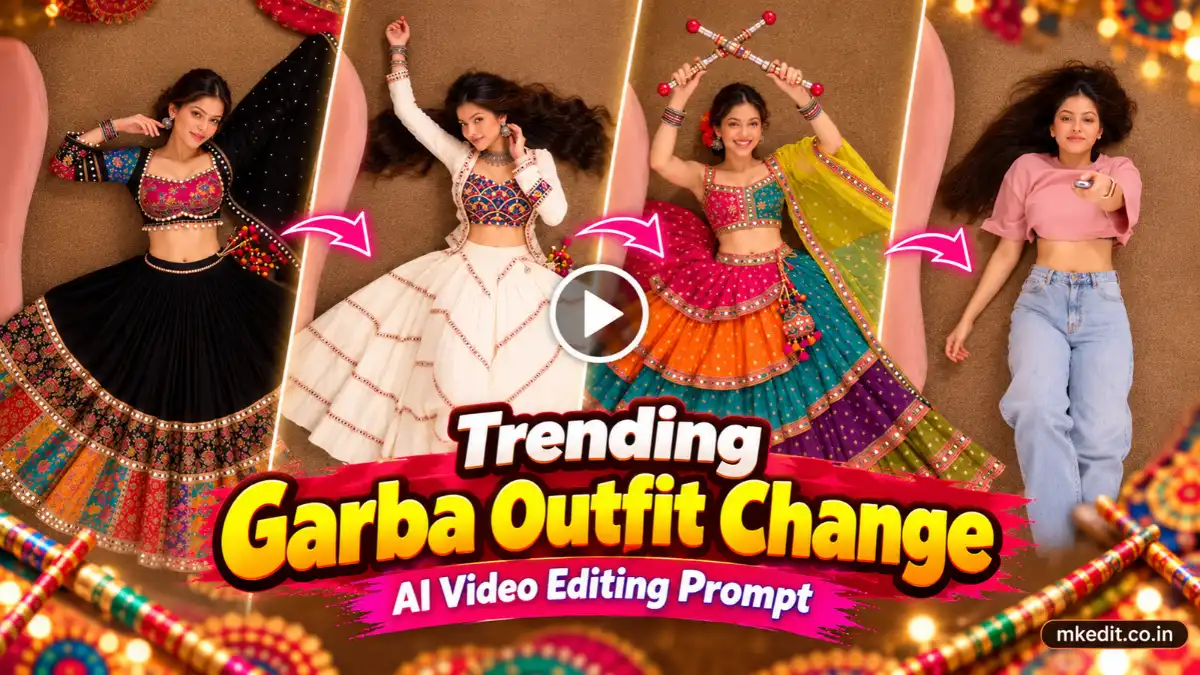
The Navratri outfit-change reel is everywhere right now: one casual look, a quick flash, and the same person is suddenly in a full Garba chaniya choli. The trick is not the transition. The trick is keeping her face identical in every frame while the clothes change.
Below you will find one detailed 10-second prompt for the viral TV-remote version, plus six more original Garba outfit change prompts with different camera angles, locations and transitions. Every prompt is ready to paste into an image-to-video AI tool along with your photo.
Quick Answer: How This Prompt Works
- Upload one clear, front-facing photo of the person (your own, or someone who has given permission).
- Paste the prompt in an image-to-video tool.
- Generate in 9:16 vertical format for Reels, Shorts and WhatsApp Status.
- If the face drifts, regenerate. Do not keep editing the prompt first.
What You Need Before You Start
- A sharp reference photo: good light, face fully visible, no heavy filters, no sunglasses.
- An image-to-video tool: for example Gemini’s video generation, Kling or Runway. Features, clip length and free limits differ by tool and plan, so check yours first.
- Vertical 9:16 setting: choose it in the tool instead of cropping later.


1. The TV-Remote Navratri Outfit Change Prompt (10 Seconds)
This is the main prompt. A fixed top-down camera, a remote click, and three outfit transformations: Gujarati chaniya choli, black Kutchi patchwork, and a white-panel Navratri lehenga. Because the camera never moves, the AI only has to change the clothes, which is why this setup keeps faces more stable.
Create a 10-second vertical 9:16 cinematic fashion reel using the uploaded image as the girl’s exact identity and appearance reference.
IDENTITY & CONSISTENCY — CRITICAL
Use the uploaded image as the primary identity reference throughout the entire video. Keep the girl’s exact face, facial structure, eyes, eyebrows, nose, lips, skin tone, hairstyle, proportions, and overall identity unchanged in every shot and after every outfit transformation.
Do not generate a different person or modify her facial features. Her face must remain visually identical from the first frame to the final frame.
CAMERA & ENVIRONMENT
Use a fixed top-down 90-degree camera angle for the entire video.
– Camera position: directly above the girl
– Camera movement: none
– Zoom: none
– Camera angle: locked at 90°
– Framing: unchanged throughout
– Background: completely unchanged
– Girl’s body position: remain consistent during all transformations
She is lying on a tan woven carpet. On the left side, there is a dusty-pink curved velvet sofa. At the bottom of the frame, a portion of a chrome lamp base is visible.
Use warm, soft studio lighting with realistic shadows and natural skin texture. The overall appearance should resemble premium 4K Indian fashion photography.
0–2.5 SECONDS — CASUAL LOOK
The girl is wearing:
– Dusty-pink oversized cropped T-shirt
– Light-blue baggy jeans
– Smartwatch
– Barefoot
She looks directly toward the camera with a natural smile.
She holds a silver TV remote above herself, points it upward toward the camera, and presses the button as if changing a television channel.
Keep the movement subtle and realistic:
– Natural blinking
– Small hand movement
– Natural facial expression
– No exaggerated body movement
2.5–5 SECONDS — GUJARATI CHANIYA CHOLI TRANSFORMATION
Immediately after the remote click, create a very fast TV channel-change flash/glitch transition.
The transition must feel like an instant outfit transformation rather than a scene change.
After the flash, she is wearing a colorful Gujarati Navratri chaniya choli featuring:
– Rainbow-style layered skirt
– Magenta, orange, teal, purple and olive-green tiers
– Rich gold mirror-work
– Fuchsia-and-teal blouse
– Neon yellow-green dupatta
– Silver jhumkas
– Colorful bangles
– Red flowers arranged in her bun
– Golden traditional sandals
She holds two crossed dandiya sticks above her head.
Her skirt is naturally spread around her on the carpet.
She smiles brightly toward the camera while maintaining essentially the same body position and composition.
The outfit should have highly detailed embroidery, realistic mirror-work reflections, authentic Indian textile texture and natural fabric folds.
5–7.5 SECONDS — BLACK KUTCHI PATCHWORK TRANSFORMATION
Create another quick TV-style flash/glitch transition.
Immediately afterward, transform her outfit into a black Kutchi patchwork Navratri outfit:
– Black flared skirt
– Colorful patchwork along the skirt hem
– Pink beaded blouse
– Black mirror-work dupatta
– Silver jhumkas
– Oxidized silver bangles
– Hair arranged in a neat bun
She rests her head gently on one hand and gives the camera a soft, natural smile.
Maintain the same overhead composition, background and overall body placement.
The clothing should look premium and authentic, with detailed Kutchi patchwork, visible stitching, mirror-work and realistic fabric texture.
7.5–10 SECONDS — FINAL NAVRATRI LEHENGA TRANSFORMATION
Create the final fast flash/glitch channel-change transition.
She instantly transforms into a white-panel Navratri lehenga featuring:
– White base
– Mustard panels
– Purple panels
– Hot-pink panels
– Decorative mirror-work border
– Pink-and-gold blouse
– White patchwork dupatta
– Red flower placed in her bun
She looks directly toward the camera, smiles naturally and gently waves at the camera.
The final frame should feel like a polished Indian Navratri fashion-reel ending shot.
MOTION & REALISM
Throughout the entire 10-second video:
– Keep the girl’s identity exactly consistent
– Keep the face unchanged
– Keep the camera completely locked
– Keep the background unchanged
– Keep the same top-down composition
– Preserve realistic body proportions
– Use natural blinking and subtle facial expressions
– Make hand movements smooth and believable
– Add realistic fabric movement during each transformation
– Make the dupatta move naturally with subtle motion
– Make bangles, earrings and mirror-work react naturally to movement
– Maintain realistic skin texture
– Maintain realistic shadows and lighting
– Make every outfit transformation instantaneous and clean
The flash/glitch transitions should be very brief, controlled and cinematic, similar to a television channel changing rapidly. The glitch must not distort the girl’s face, body or background.
FINAL VISUAL STYLE
Premium Indian festive fashion reel, cinematic realism, realistic 4K photography, rich Navratri colors, highly detailed embroidery, authentic Gujarati and Kutchi textile details, realistic mirror-work, natural skin texture, realistic fabric physics, warm studio lighting, sharp subject detail, polished fashion-commercial quality.
NEGATIVE PROMPT
Do not change the face, do not change identity, no face morphing, no facial distortion, no different person, no skin-tone change, no hairstyle inconsistency, no body-shape distortion, no extra fingers, no missing fingers, no deformed hands, no duplicated limbs, no outfit mixing, no incorrect outfit colors, no incorrect accessories, no background change, no camera movement, no camera rotation, no zoom, no reframing, no perspective change, no scene change, no excessive motion blur, no flickering face, no unstable identity, no blurry embroidery, no low-detail fabric, no cartoon appearance, no CGI look, no text, no subtitles, no logo, no watermark.
Best for: Instagram Reels and YouTube Shorts where you want three looks in one clip.
Tip: If your tool only allows 5–6 seconds per clip, run each outfit block as its own clip and join them in any video editor with a quick flash cut.
More Garba Outfit Change Prompts With Different Styles
The first prompt uses a locked top-down camera. The prompts below change the camera, location and transition so you do not end up with the same reel as everyone else. Each one includes its own identity-lock line, written differently, so you can see several ways to protect the face.
2. Mirror Finger-Snap Garba Transformation
A front-facing mirror setup that feels like a real “getting ready for Garba night” clip. The finger snap gives the AI a clear moment to switch outfits.
Create an 8-second vertical 9:16 video of a young woman standing in front of a full-length wardrobe mirror in a bright Gujarati family home. Shoot it as a steady medium-wide shot at eye level.
Treat the attached reference photo as the only source for her face and identity. Every facial feature must stay exactly as it appears in that photo, from the first frame to the last.
She begins in an oversized white shirt and black joggers, hair in a loose ponytail, phone in one hand. She looks at the camera, grins, and snaps her fingers once. On the snap, a quick warm golden light sweep crosses the frame and she is instantly wearing a deep red bandhani chaniya choli with a mirror-work yoke, a gota-lace dupatta pinned over one shoulder, oxidized silver jewellery and a small gajra in her hair.
She adjusts the dupatta, does one small clap-and-sway Garba step, and finishes with a confident smile.
Natural window light with soft fill, a few diyas on a side table, shallow depth of field, sharp fabric detail, realistic skin texture. The camera stays still apart from a very slight handheld feel.
Avoid face changes, extra fingers, warped or mismatched mirror reflections, background changes, text and watermarks.
Best for: “Getting ready” reels and festive story-style content.
Tip: Mirrors are hard for AI. If the reflection looks wrong, replace the mirror with a plain wall and a standing pose.
3. Dandiya Night Clap-Transition
The outfit changes on a single clap, with a blurred Garba ground behind her. It looks closest to what people actually film at Navratri events.
Make a 10-second 9:16 video in a medium shot at eye level, set at an outdoor Navratri Garba ground at night. String lights glow overhead and soft, out-of-focus dancers move in the background.
Her face must match the attached reference image exactly. Do not smooth, reshape or alter any facial feature at any point in the video.
In the first three seconds she wears a plain black kurta with blue jeans and holds a pair of dandiya sticks, looking slightly off-camera as if waiting for the music. Then she claps once. A short burst of warm light flashes and she is wearing a parrot-green and yellow chaniya choli with heavy mirror embroidery, a bright pink dupatta, stacked bangles and silver jhumkas.
For the rest of the clip she taps the dandiya sticks in front of her, turns a quarter-circle and smiles toward the camera. Skirt ripples with each step, mirror-work catches the string lights, jewellery moves naturally.
Warm festival lighting, rich colors, realistic skin tones, crisp embroidery detail. Keep the camera steady with only a very slow push-in.
No background crowd faces in focus, no warped hands, no extra dandiya sticks, no text, no logo.
Best for: Event-style reels and Navratri greeting videos.

4. Twirl Transformation at a Dusk Courtyard
Here the spin hides the outfit switch, so you do not need a flash transition. Good if you want something softer and more cinematic.
Create a 9-second vertical cinematic clip of a woman in a traditional Gujarati courtyard at dusk. Use a low three-quarter camera angle at waist height, slightly tilted upward. Marigold garlands hang from a wooden doorway and a row of lit diyas glows along the floor.
Keep the person from the reference image unchanged: same face, same features, same identity in every frame, with no beautification or alteration.
She starts in an oversized grey hoodie and straight jeans, arms crossed, looking calm. She lifts her arms and begins a full spin. As her body turns away from the camera and back, the casual clothes dissolve into a royal-blue and orange chaniya choli with a wide flared skirt, gold border, mirror-work blouse and a sheer orange dupatta.
She finishes facing the camera, the skirt still settling, and gives a soft smile.
Lighting: warm sunset glow from the left mixed with the flicker of diyas. Fabric should flare and fall naturally. Shallow depth of field, sharp detail on embroidery and jewellery, realistic skin.
No face warping during the spin, no duplicate limbs, no sudden background change, no text or watermark.
Best for: Smooth, cinematic reels with a traditional mood.
5. Kediyu Outfit Change for Men
Most Garba outfit change prompts are written only for women. This one covers the Gujarati kediyu look for men.
Create an 8-second vertical 9:16 video of a young man standing in the middle of a haveli-style courtyard decorated with marigold flowers. Use a steady eye-level medium shot with a very gentle 15-degree arc around him.
Use the uploaded photo as a strict identity guide. His face, beard, hairline and overall look must remain unchanged through every frame.
He begins in a plain grey T-shirt and chinos, adjusting his watch. He glances at the camera, takes a deep breath and does a quick shoulder shrug. A brief shimmer of golden light passes across the frame and he is now wearing a white cotton kediyu with colorful hand-embroidered patchwork, matching churidar, a bright bandhani safa on his head, and traditional leather juttis.
He places one hand on his chest, gives a short nod and a confident smile.
Warm afternoon light, natural skin texture, clear cotton fabric folds, visible embroidery stitching.
No face changes, no beard changes, no extra fingers, no costume-party look, no text or watermark.
Best for: Male creators, couples content and family Navratri videos.
6. Vanity Table Getting-Ready Look

A close, intimate shot where the outfit is only partly visible. Easier for the AI to keep the face stable, because the framing is tight.
Create a 7-second vertical video, close-up portrait framing from chest up, seated at a vintage wooden vanity table with warm bulb lights around the mirror. The camera is front-on and almost still.
Take the face and identity directly from the attached reference picture and keep it fixed. Her makeup stays natural and light; only her clothing and accessories are allowed to change.
She starts in a simple cotton night-suit with her hair loosely clipped, holding a pair of silver jhumkas. She lifts the earrings toward her ears and a soft white flash passes. In the next moment she is dressed in a maroon Navratri blouse with gold mirror-work, a matching dupatta over her head, silver jhumkas on, a small bindi and a mogra gajra.
She looks into the camera, tilts her head slightly and smiles.
Soft warm lighting, glowing skin with realistic texture, shallow depth of field, sharp jewellery detail.
No change to facial structure, no uneven earrings, no distorted hands, no text.
7. Three-Panel Garba Look Image (No Video Needed)
If you only want an image, or your tool does not support video, use this. It shows three outfits in one frame and works well as a Reel cover or a carousel slide.
Create one vertical 4:5 image divided into three equal horizontal panels, showing the same woman in three different Navratri looks. All three panels share one warm, softly lit studio background and the same standing pose, hands gently holding the dupatta.
The face and identity come from the attached reference image and must be identical in all three panels. Nothing about her features should be edited, enhanced or replaced.
Panel one: a classic multicolor chaniya choli with gold border and mirror-work. Panel two: a black Kutchi patchwork skirt with a pink beaded blouse and oxidized silver jewellery. Panel three: an ivory lehenga with mustard and purple panels and a red flower in her hair.
Ultra-sharp detail, realistic fabric texture, accurate mirror-work reflections, natural skin tones, clean fashion-editorial look.
No text, no panel labels, no watermark, no face variation between panels.
How to Use These Prompts Step by Step
- Pick the prompt that matches your photo. A full-body photo works best for prompts 1, 3 and 5. A face close-up works best for 6.
- Upload your photo in the tool’s image-to-video or reference-image field.
- Paste the full prompt, including the identity and negative lines.
- Choose 9:16 and the longest duration your plan allows, up to the clip length in the prompt.
- Generate two or three versions and choose the one where the face stays steadiest.
How to Customize the Prompts
- Change the outfit colors: replace the color names but keep the garment structure (tiers, panels, border, dupatta style).
- Change the location: a rooftop, a temple courtyard, a pandal or a living room all work if you describe light and background in one line.
- Change the transition: try a clap, a finger snap, a spin, a door opening or a petal burst. Pick one per clip.
- Match your photo: if your photo is indoors with warm light, do not ask for a cold blue night scene. The AI struggles to keep the face consistent when lighting differs a lot.
Common Mistakes That Ruin the Result
- Using a blurry or filtered photo. The AI copies the blur and the filter.
- Asking for too many changes at once. Three outfits are fine; three outfits plus camera moves plus a new location usually are not.
- Moving the camera during the outfit change. Lock it for the transformation, then add motion only if needed.
- Skipping the negative prompt. Face morphing and extra fingers are the most common problems, and the negative line helps reduce them.
- Using someone else’s photo without permission. Only use your own pictures or those of people who have agreed.
Frequently Asked Questions
Which AI tool is best for the Garba outfit change video?
Any tool that lets you upload a reference image and generate a vertical video can work. Results vary by tool and by photo, so try the same prompt in two tools before settling.
Why does the face change after the outfit transformation?
The AI often redraws the person when a big change happens. Use a sharp reference photo, keep the camera locked, and keep the identity lines in the prompt. If it still drifts, regenerate.
Can I use these prompts for images?
Yes. Prompt 7 is written for a single image. For the others, remove the time-based parts and describe one outfit.
What video size should I use?
Use 9:16 vertical for Instagram Reels, YouTube Shorts and WhatsApp Status.
Can I change the outfits to something other than Garba?
Yes. Keep the transition and camera lines and replace only the outfit descriptions, for example with wedding, Diwali or Holi looks.
Final Words
Start with the TV-remote prompt if you want the trending look, then try the mirror or twirl versions if you want something different from other creators. Keep the photo sharp, keep the camera simple, and let the outfit be the only thing that changes.

Hi, I’m Deepak Verma. I run MKEdit because I got a little obsessed with how good AI photo prompts can look when they’re written properly and paired with the right AI tools to generate high-quality images. Everything you see here, I’ve generated and tested myself first. If it’s on the site, it’s because it actually gave a good result — not just a random idea I typed once